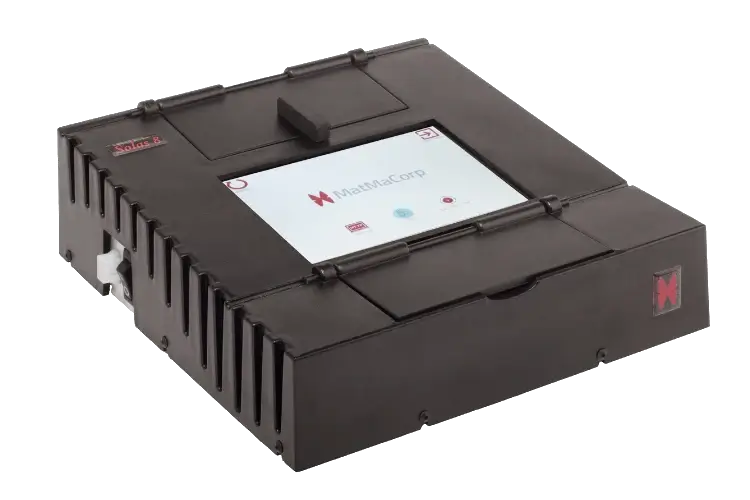
SOLAS 8: Portable Thermal Cycler
Precision Thermal Engineering & PID Control
Python
C/C++
PID Control
Solidworks
Thermal Modeling
A rugged, portable PCR device designed for high precision DNA amplification in the field or lab.
The Engineering Deep Dive
The SOLAS 8 was designed to take PCR (Polymerase Chain Reaction) out of the lab and into the field. This required a total rethink of thermal stability, ease of use, and chemical availability. Standard lab equipment relies on heavy heat sinks, constant power, and a centrifuge. The SOLAS was designed to isolate DNA and RNA without the need for a centrifuge by using a custom method relying on holding a stable temperature and shippable extraction equipment. The precession of temperature was key not only for extraction but also for thermal cycling. The device also needed to keep that precision while running in dirty, temperature diverse, environments. The device ran from pig farms, USDA cow studies, all the way to Lemurs in Madagascar and animals in Tanzania.
I was responsible for improving the thermal modeling and the control logic. Using Solidworks, I designed the aluminum well blocks to maximize surface area contact with the heating elements, while minamizing mass for cooling. The software challenge involved creating a predictive PID loop that could ramp temperatures up to 95 C and down to 55 C without or overshooting; while scanning each well at the correct temperature and time.
The Technical Post Mortem
The SOLAS 8 was a lesson in thermal management. The core challenge was implementing a PID control loop that could handle rapid 'ramping' (heating/cooling) without overshoot in a confined space and with different external conditions.
I developed a predictive cooling logic that accounted for the thermal inertia of the aluminum blocks. This project also required significant CAD work in Solidworks to ensure the internal components remained cooled while the heating elements reached peak temperatures.
Engineering Constraints
Solving for the 'Impossible' means navigating rigid physical and computational limits:
- Managing high current thermal cycling in a variable temperature landscape.
- Maintaining 0.1°C precision across 8 wells simultaneously.
- Designing for durability and field usability.